What is an Example of an Educational Toy? Top Picks & Benefits
Educational Toy Matchmaker
Select your child's age group to see recommended toys and their developmental benefits.
Recommended Toy Analysis
Toy Name
Description goes here...
Reasoning...
You’re standing in the toy aisle, staring at a wall of bright plastic and flashing lights. One box promises to teach your toddler calculus; another claims it will make them a musical prodigy by age three. It’s overwhelming. You want something that actually helps their brain grow, not just keeps them quiet for twenty minutes while you drink coffee. So, what is an example of an educational toy that actually delivers on that promise?
Here is the truth: there is no single "best" toy. An educational toy is any plaything designed specifically to promote cognitive, physical, social, or emotional development in children. However, the most effective examples share one trait: they require active participation from the child rather than passive observation.
| Age Group | Toy Type | Primary Skill Developed | Why It Works |
|---|---|---|---|
| 0-12 Months | Wooden Ring Stacker | Fine Motor Skills & Cause-and-Effect | Teaches hand-eye coordination and object permanence without batteries. |
| 1-3 Years | Shape Sorter | Problem Solving & Spatial Awareness | Requires matching shapes to holes, building logical thinking patterns. |
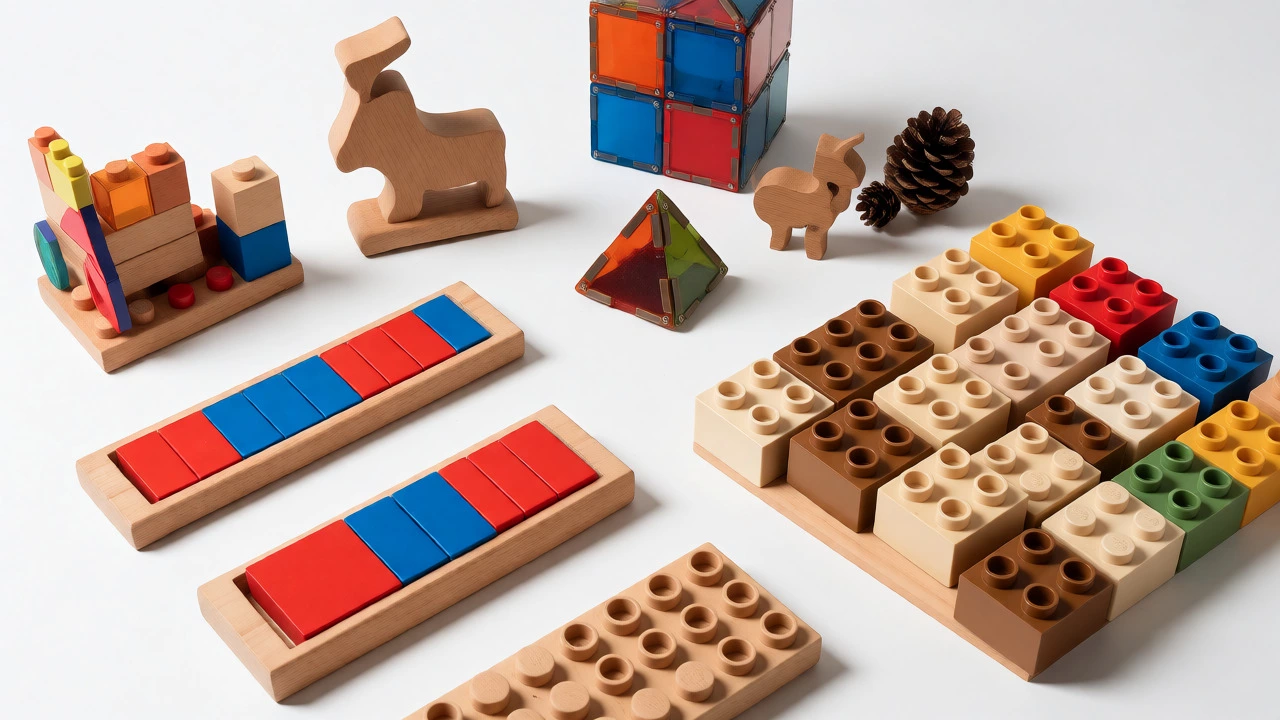
| 3-5 Years | LEGO Duplo | Creativity & Engineering Basics | Open-ended construction allows for infinite combinations and storytelling. |
| 5-8 Years | Magnetic Tiles (e.g., Magna-Tiles) | Geometry & Structural Integrity | Visualizes 2D to 3D conversion intuitively through play. |
| 8+ Years | Robotics Kit (e.g., LEGO Mindstorms) | Coding Logic & Sequencing | Introduces programming concepts through tangible hardware feedback. |
The Classic Contender: Wooden Building Blocks
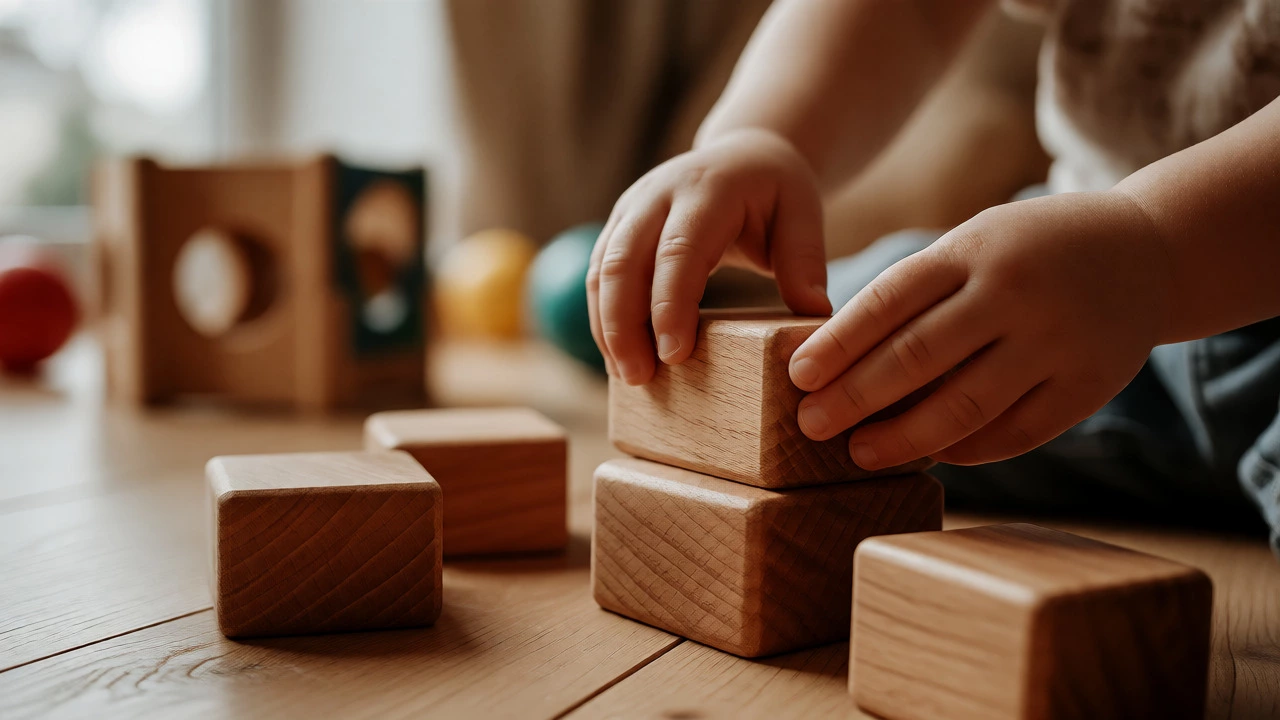
If you had to pick one universal answer to "what is an example of an educational toy," wooden blocks would be it. They have survived centuries because they scale with your child. A one-year-old stacks them to learn gravity. A five-year-old builds castles to practice narrative structure. An eight-year-old uses them to understand symmetry and balance.
Unlike electronic toys that do the work for the child, blocks are "open-ended." This means the toy has no single correct way to be played. Psychologists call this high-quality play because it forces the brain to create rules, solve problems, and imagine outcomes. When your kid knocks over a tower, they aren't just making noise; they are testing physics. That is real learning happening in real-time.
Montessori Materials: Learning Through Touch
Maria Montessori revolutionized early childhood education by proving that children learn best when they manipulate objects themselves. A prime example here is the Montessori Number Rods. These look like simple wooden bars painted in alternating red and blue segments. But don’t let the simplicity fool you.
Each rod represents a number based on its length. The child holds the rods, feels the weight difference, and visually sees the progression from 1 to 10. This tactile experience grounds abstract mathematical concepts in physical reality. Before a child can write the number "5," they need to feel what "fiveness" looks and feels like. This type of sensory-based learning creates stronger neural pathways than flashcards ever could.
STEM Toys: Beyond the Buzzword
STEM stands for Science, Technology, Engineering, and Math. But many parents mistake flashy gadgets for true STEM tools. A genuine STEM toy teaches logic and iteration. Take circuit kits, for instance. When a child connects a battery, wires, and a light bulb, they aren't just playing; they are debugging. If the light doesn't turn on, they have to figure out why. Was the connection loose? Did they reverse the polarity?
This process mirrors how engineers work. It builds resilience. In a world where kids often get instant gratification from screens, struggling with a broken circuit teaches patience. It shows that failure isn't final-it's just data telling you what to fix next.
Language and Literacy Tools
Vocabulary expands rapidly between ages two and five. Magnetic letters are a fantastic example of an educational toy that bridges the gap between speaking and reading. Unlike alphabet charts that sit on a wall gathering dust, magnetic letters invite interaction.
Your child can spell their name, build words for things they see around the house, or even rearrange letters to make new sounds. This hands-on manipulation demystifies spelling. It turns language into a game of construction. Plus, because they are magnets, they stick to the fridge, turning everyday moments into micro-lessons. "Hey, can you find the letter 'B' for banana?" becomes a natural part of snack time.
Social-Emotional Learning (SEL) Toys
We often forget that school readiness isn't just about counting. It’s about sharing, negotiating, and managing frustration. Board games are powerful SEL tools. Games like Candy Land or Chutes and Ladders teach turn-taking. For older kids, cooperative games like Hoot Owl Hoot! remove the pressure of winning against others. Everyone wins together, or everyone loses together.
This shifts the focus from competition to collaboration. Children learn to communicate strategies and support each other. These soft skills are often more predictive of future success than raw IQ scores. An educational toy that fosters empathy is just as valuable as one that teaches multiplication.
How to Choose the Right Educational Toy
Not every toy fits every child. Here is a quick checklist to help you decide:
- Is it open-ended? Can it be played with in multiple ways? If yes, it likely offers longer engagement.
- Does it match their current skill level? Too hard leads to frustration; too easy leads to boredom. Look for toys slightly above their current ability (the "zone of proximal development").
- Is it durable? Wood and thick plastic last longer than flimsy electronics. Durability matters for safety and sustainability.
- Does it encourage conversation? The best educational toys spark questions between parent and child.
Avoid toys that claim to teach specific academic subjects to infants under twelve months. At that stage, sensory exploration-touching textures, hearing sounds, seeing contrasts-is the primary curriculum. Flashcards for babies are mostly marketing hype.
Common Pitfalls to Avoid
Beware of "passive" educational toys. These are toys that do everything for the child. You press a button, and it sings, flashes, and talks. After ten seconds, the child walks away. There was no problem to solve, no creativity required. Compare this to a set of art supplies. Art supplies do nothing until the child picks up a brush. The child provides the intent, the effort, and the outcome. That agency is crucial for learning.
Also, watch out for overstimulation. Toys with loud noises and rapid flashing lights can overwhelm young nervous systems. Calm toys often lead to deeper focus. As a parent in Vancouver, I’ve noticed that nature-based toys-like stones, pinecones, or wooden animals-often hold attention longer than plastic counterparts because they invite imaginative scenarios.
Next Steps for Parents
Don’t try to buy everything at once. Start with one high-quality item that aligns with your child’s current interests. If they love cars, get a ramp set to explore speed and distance. If they love animals, get figurines to build habitats. Observe how they play. Do they line them up? Build stories? Smash them together? Each behavior reveals what they are learning.
Remember, the toy is just a tool. You are the educator. Your interest, your questions, and your willingness to get on the floor and play matter more than the price tag on the box. An expensive robot ignored in a corner teaches less than a cardboard box explored with enthusiasm.
Are digital apps considered educational toys?
They can be, but with caveats. High-quality interactive apps that require input and provide feedback (like coding games or puzzle solvers) offer some educational value. However, they lack the tactile, multi-sensory experience of physical toys. Passive video watching is generally not considered educational play for young children.
At what age should I start giving educational toys?
Play starts at birth. For newborns, high-contrast mobiles and rattles are educational because they develop vision and auditory tracking. Formal "toys" become more structured around six months when grasping begins. Always choose age-appropriate items to ensure safety and relevance.
Do expensive toys teach better than cheap ones?
No. Price does not correlate with educational value. A $5 bag of dried beans can teach sorting, pouring, and fine motor skills just as effectively as a $50 sensory bin kit. Simplicity often promotes deeper creativity. Expensive toys sometimes over-feature, which limits imagination.
How many educational toys should a child have?
Less is often more. Clutter reduces focus. Rotating a small selection of 5-10 toys keeps interest high. When a toy is put away for a few weeks and then brought back, it feels new again. This strategy prevents burnout and encourages deep engagement with fewer items.
Can household items be educational toys?
Absolutely. Pots and pans are drums. Cardboard boxes are spaceships or houses. Measuring cups teach volume. Household items are excellent because they connect learning to real-life contexts, helping children understand the function of everyday objects.