Pet Gate vs Child Gate: Key Differences, Safety Standards, and Which One You Need
Pet vs. Child Gate Safety Analyzer
Answer these questions to find the right barrier for your home.
Analysis Result
Recommended Action:
Select your options and click Analyze to see if your gate setup meets safety standards.
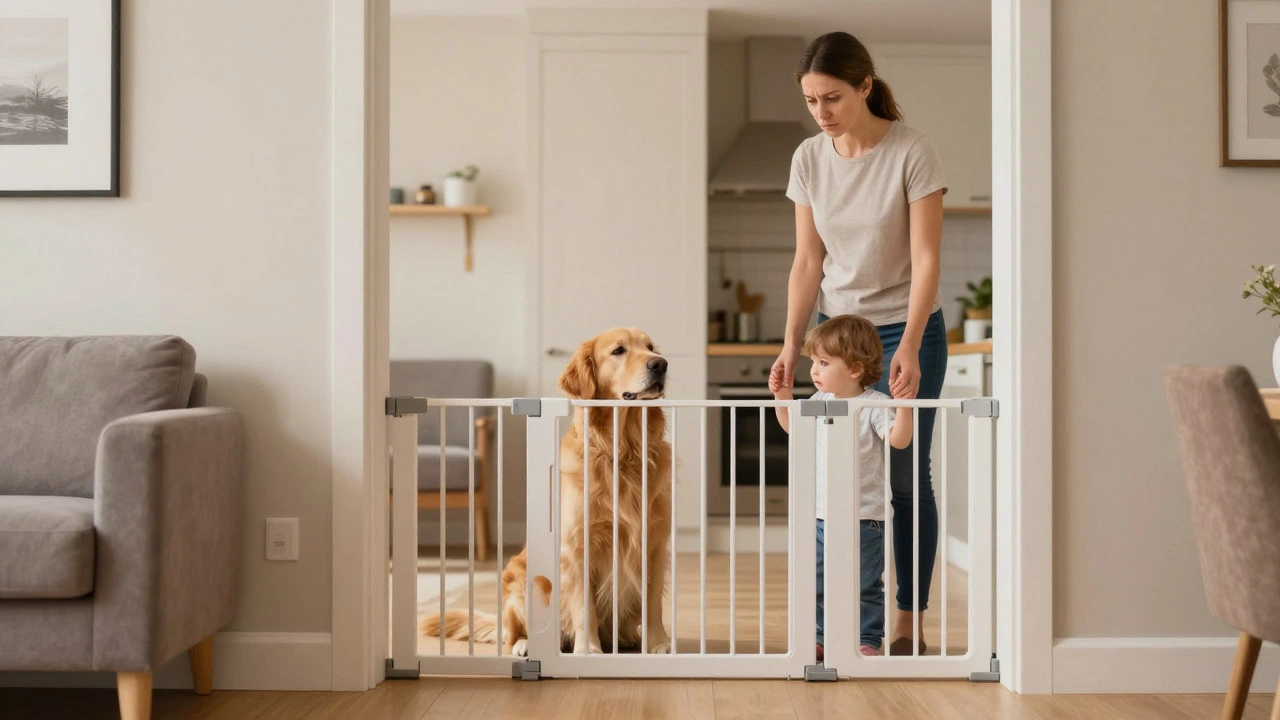
You stand in the doorway, looking at the gap between your living room and kitchen. Your toddler is learning to walk, and your golden retriever has a habit of bolting for the back door whenever someone rings the bell. You need a barrier. But do you buy a pet gate or a child gate? It’s a question that trips up many parents, especially those with furry family members. The short answer? They look similar, but they are built for very different forces.
Using a pet gate for a child can be dangerous. Using a child gate for a large dog might result in a broken gate and a messy floor. Understanding the structural differences, safety certifications, and mounting methods is crucial for keeping both your little ones and your pets safe.
The Core Difference: Force and Intent
At their heart, child safety gates are designed to withstand the weight and momentum of a human child. A two-year-old doesn’t just push against a gate; they climb it, hang from it, and sometimes throw themselves into it. Pet gates, on the other hand, are designed to contain animals that may jump, scratch, or nudge, but rarely apply sustained vertical or horizontal force in the same way a human does.
Think about the physics. A 30-pound dog jumping up applies a quick, sharp impact. A 35-pound toddler leaning all their weight onto the top rail applies constant, crushing pressure. Child gates are engineered with thicker steel or reinforced wood to handle this static load. Pet gates often use lighter materials like plastic, thin wire, or lightweight aluminum because they don’t need to support a climbing human.
Safety Standards and Certifications
This is where the rubber meets the road-literally. In North America, child gates must meet specific safety standards set by organizations like the Consumer Product Safety Commission (CPSC) and tested by independent labs like ASTM International.
- ASTM F1004: This is the standard specification for safety gates. It dictates everything from the spacing of vertical bars (to prevent head entrapment) to the strength of the latch mechanism.
- JPMA Certification: Look for the seal from the Juvenile Products Manufacturers Association. This means the gate has been independently tested and verified to meet ASTM standards.
Pet gates generally do not have these rigorous requirements. While a high-quality pet gate might be sturdy, it hasn’t necessarily been tested for head entrapment risks or latch failure under the stress of a climbing child. If you see a gate labeled "for pets only," assume it lacks the CPSC compliance required for children.
Mounting Methods: Pressure vs. Hardware
How the gate attaches to the wall or door frame is a major differentiator. There are two main types: pressure-mounted and hardware-mounted.
| Feature | Pressure-Mounted | Hardware-Mounted |
|---|---|---|
| Installation | No tools needed; uses tension screws | Requires drilling screws into wall/frame |
| Best For | Top of stairs (with caution), hallways, rooms | Top of stairs, high-traffic areas, heavy use |
| Security | Moderate; can be pushed open if leaned on hard | High; nearly impossible to dislodge by force |
| Damage to Walls | Minimal (small indentations) | Small screw holes (easily patched) |
Pressure-mounted gates work by twisting a central rod to expand the gate against the walls. Most pet gates are pressure-mounted because they are easy to move around as you clean or rearrange furniture. However, for a child, especially at the top of a staircase, a pressure-mounted gate can fail if the child leans heavily on it. That’s why hardware-mounted gates are non-negotiable for stair tops.
Hardware-mounted gates are screwed directly into the wall or door jamb. They are heavier, more expensive, and harder to install, but they provide the security needed for active toddlers. Some premium pet gates offer hardware-mounting options, but they still lack the structural reinforcement of a true child gate.
Latch Mechanisms: Dexterity Matters
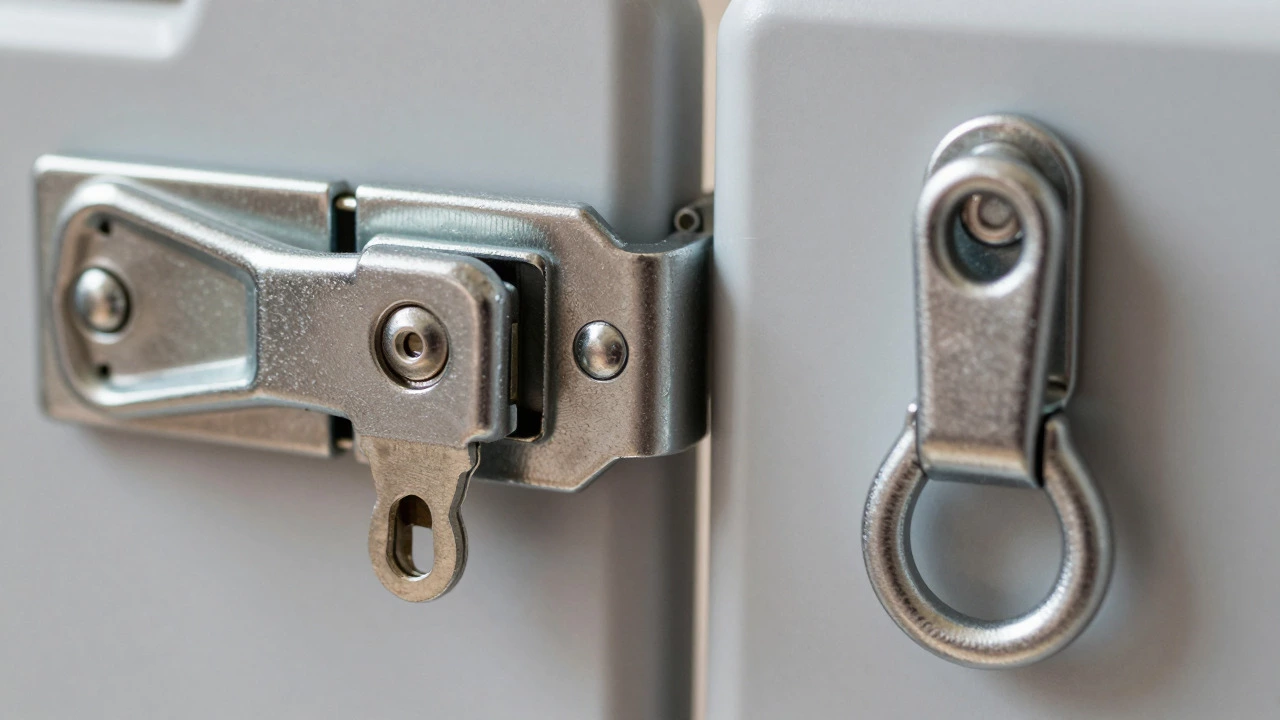
Have you ever tried to open a gate while holding a crying baby and a diaper bag? The latch design is critical. Child gates feature latches that require a certain level of dexterity to open-usually a double-action mechanism (lift and pull, or twist and push). This prevents curious toddlers from figuring out how to escape.
Pet gates often have simpler latches, such as a single hook, a magnetic catch, or a simple slide bolt. These are easy for adult hands to operate quickly, which is great when you’re rushing to let the dog out, but terrible for child safety. A toddler can easily manipulate a simple hook or slide bolt within days of discovering it.
Additionally, child gates often include a "lockout" feature or a key-operated lock to ensure that even if the child figures out the mechanism, they can’t open it without the key. Pet gates rarely have this feature.
Material and Design Considerations
The materials used reflect the intended user. Child gates are typically made from solid wood, thick steel mesh, or heavy-duty plastic with wide vertical bars. The bar spacing is strictly regulated to be less than 3 inches apart to prevent a child’s head from getting stuck.
Pet gates vary widely. You’ll find:
- Wire mesh gates: Great for visibility and airflow, but small dogs or cats can sometimes chew through or slip through if the mesh is too loose.
- Plastic accordion gates: Cheap and flexible, but notoriously weak. They can collapse under the weight of a medium-sized dog or a determined toddler.
- Bamboo or wooden slat gates: Aesthetic and sturdy, but often marketed as decorative pet barriers rather than safety devices.
If you have a cat, a standard child gate might not work because cats can climb over or squeeze through gaps. Conversely, a wire pet gate might be too flimsy for a climbing toddler. This is why some families end up buying two separate gates: one for the kids and one for the pets.
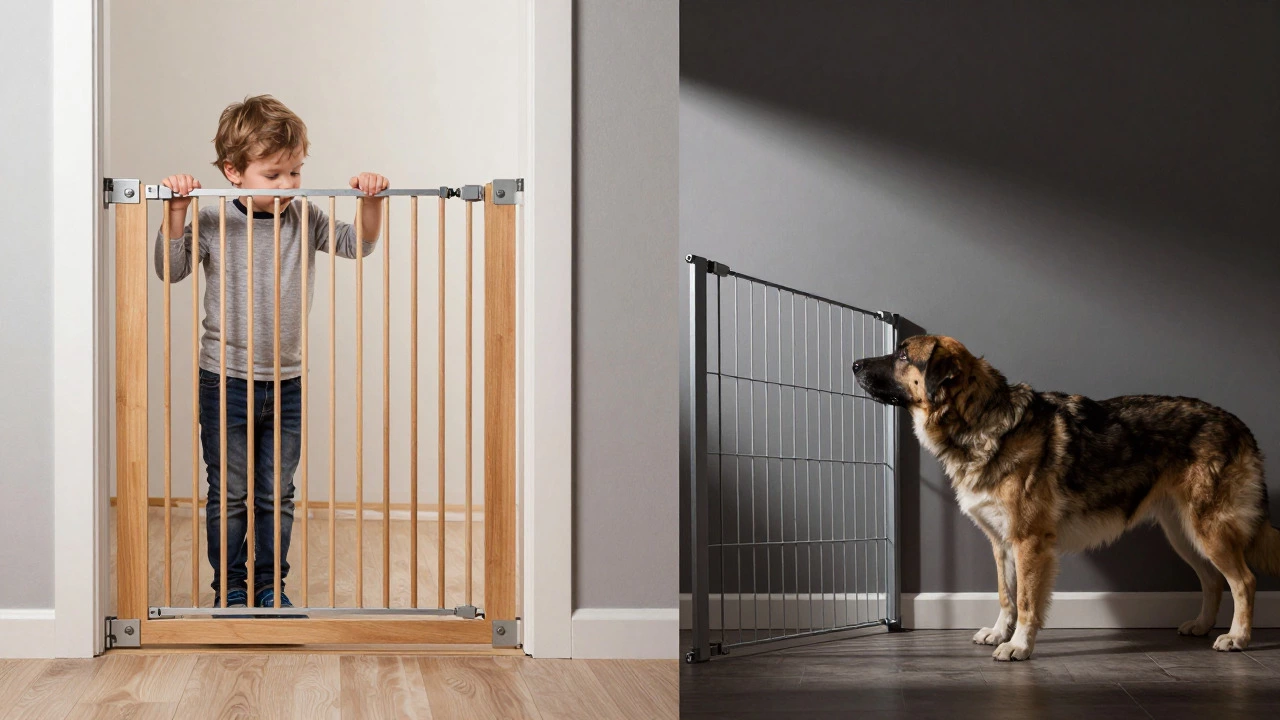
Can You Use a Pet Gate for a Child?
Technically, yes, but it’s risky. If the pet gate is hardware-mounted, made of heavy steel, has narrow bar spacing, and a complex latch, it *might* hold up. However, unless it is explicitly certified to ASTM F1004 standards, you are gambling with your child’s safety. Insurance companies may also deny claims if an injury occurs behind a non-compliant gate.
On the flip side, can you use a child gate for a pet? Absolutely. In fact, it’s often the better choice for large, strong dogs. A child gate will withstand a Labrador’s charge far better than most pet-specific gates. The downside is cost and installation effort. Child gates are more expensive and harder to put up and take down daily.
Choosing the Right Gate for Your Home
To make the right choice, ask yourself these questions:
- Who is the primary user? If it’s a child, prioritize safety certifications. If it’s a pet, consider their size and behavior.
- Where will it go? Top of stairs? Hardware-mounted child gate only. Hallway? Pressure-mounted might suffice for both, but check the width.
- What is the width of the opening? Many gates extend to fit wider spaces, but stability decreases as the gate gets wider. Measure carefully.
- Do you have multiple users? If you have both a toddler and a large dog, invest in a high-quality, hardware-mounted child gate. It protects everyone.
Don’t skimp on safety. A cheap pet gate might save you $20 today, but a fall down the stairs or a child wandering into the street is a price no one wants to pay. When in doubt, choose the gate designed for the most vulnerable member of your household: the child.
Are pressure-mounted gates safe for the top of the stairs?
Generally, no. Most safety experts and manufacturers recommend using only hardware-mounted gates at the top of stairs. Pressure-mounted gates can detach if a child leans or climbs on them, leading to a serious fall. At the bottom of stairs, a sturdy pressure-mounted gate is usually acceptable.
What is the best type of gate for a large dog?
For large breeds like German Shepherds or Huskies, a hardware-mounted child safety gate is often the best option. Look for one with a steel mesh or solid wood construction. Avoid wire mesh or plastic gates, as large dogs can jump, push, or chew through them.
Do I need a gate certified by JPMA?
If you are using the gate for a child, yes. The JPMA (Juvenile Products Manufacturers Association) certification ensures the gate has been independently tested to meet ASTM safety standards. For pets, it is less critical, but still a good indicator of quality.
Can cats get through child safety gates?
Some cats can. If the gate has vertical bars, a clever cat might climb over it. If it has a mesh panel, a small cat might try to squeeze through. For cats, you may need a taller gate or one with an extended top flap to prevent jumping.
How wide can a safety gate be?
Most standard gates extend to fit openings up to 36-40 inches. For wider doorways or arches, you need an extra-wide model or an extension kit. Keep in mind that the wider the gate, the less stable it may be, especially if pressure-mounted.