When to Turn Child Forward-Facing: Safety Guide & Age Limits
Car Seat Safety Checker
Enter your child's measurements and your specific car seat's maximum rear-facing limits to see the recommended direction.
Child Measurements
Car Seat Rear-Facing Limits
You’re driving down the highway, glancing in the rearview mirror at your toddler’s bright eyes staring back at you from a forward-facing car seat. It feels like a milestone, doesn’t it? A sign that they’ve grown up. But here is the uncomfortable truth that many parents miss: turning your child forward too early might be one of the most dangerous decisions you make for their safety. It’s not just about comfort or letting them see out the window; it’s about physics and fragile bones.
The old rule of thumb-turning them around when they hit age two-is outdated. Current data suggests that keeping kids rear-facing as long as possible is significantly safer. So, when is the right time? And more importantly, how do you know if your specific child and car seat setup are ready for the flip?
Why Rear-Facing Is Safer Than You Think
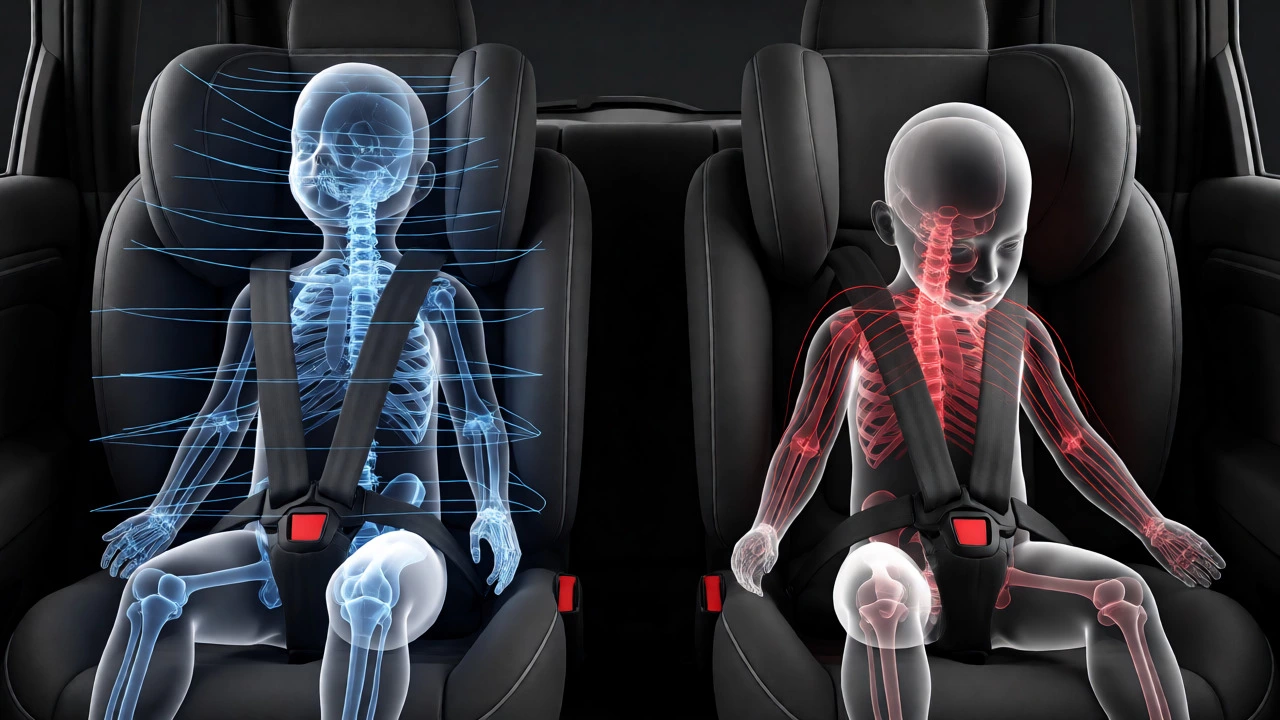
To understand why the timing matters, you have to look at what happens during a crash. In a frontal collision, which accounts for the majority of severe accidents, the force pushes everything forward. If a child is facing backward, the shell of the car seat acts as a protective cradle, distributing the impact across the entire back of the child’s body-the head, neck, and spine. The energy dissipates evenly.
Now, imagine that same crash with a forward-facing child. Their torso is restrained by the harness, but their head moves forward. Because toddlers have disproportionately large heads and weak neck muscles, this sudden jerk puts immense strain on the cervical spine. This can lead to serious injuries, including spinal cord damage. Keeping them rear-facing allows the seat to absorb the shock, protecting those vulnerable areas until their skeletal structure is stronger.
| Factor | Rear-Facing Seat | Forward-Facing Seat |
|---|---|---|
| Impact Distribution | Across entire back, head, and neck | Concentrated on chest and shoulders |
| Head Movement | Minimal relative to body | Significant forward throw |
| Spinal Stress | Low (supported) | High (risk of whiplash/spinal injury) |
| Recommended Age | Birth to max limits (often 4+ years) | After exceeding rear-facing limits |
The Myth of "Age Two"
For years, the standard advice was simple: turn the seat when the child turns two. That guideline came from an era when seats had lower weight limits and different safety standards. Today, the American Academy of Pediatrics (AAP) recommends keeping children rear-facing as long as possible, until they reach the maximum height or weight limit allowed by their specific car seat manufacturer.
Many modern convertible seats allow rear-facing use up to 40 or even 50 pounds. This means a healthy four-year-old can still ride safely in a rear-facing position. Don’t let peer pressure or outdated family advice rush you. Just because your neighbor’s three-year-old faces forward doesn’t mean yours has to. If your child fits within the rear-facing limits, keep them there. It’s not about being overprotective; it’s about using the engineering designed to save lives.
How to Check Your Car Seat Limits
Every car seat is different. You cannot rely on general age charts alone. You need to check the labels on your specific model. Here is how to determine if your child has truly outgrown the rear-facing mode:
- Check the Height Limit: Look for the top of the child’s ears. Most manufacturers state that once the tops of the ears pass the highest slot for the shoulder straps, the child is too tall for rear-facing. Some seats also specify that the head must be at least one inch below the top of the seat shell.
- Check the Weight Limit: Weigh your child without heavy coats. Compare this number to the maximum rear-facing weight listed on the seat’s label or manual. If they exceed this number, you must switch modes.
- Check the Harness Position: For rear-facing, the harness straps should come from slots at or slightly below the child’s shoulders. If you have to move the straps to the highest setting and they are still above the shoulders, the seat may no longer fit properly.
If your child hits either the height or weight limit, it’s time to consider the transition. However, if they are under both limits, stick with rear-facing regardless of their age or protests.
Preparing Your Toddler for the Change
Transitioning isn’t just a mechanical swap; it’s a behavioral shift. Toddlers are observant and often resist change. If you suddenly flip the seat without warning, you might face a meltdown every time you buckle them in. Start preparing them weeks in advance.
Talk about the "big kid seat" positively. Show them pictures of older siblings or friends riding forward-facing. Let them help pick out new toys or snacks for the front-facing journey. When you finally make the switch, ensure the installation is perfect. A loose seat is dangerous, especially in forward-facing mode where the tether strap plays a critical role.
The Importance of the Tether Strap
One common mistake parents make when switching to forward-facing is forgetting the top tether. This strap connects the top of the car seat to an anchor point in your vehicle. Without it, the seat can rotate forward excessively during a crash, increasing the risk of head injury. Always use the tether for forward-facing installations, unless your vehicle owner’s manual explicitly forbids it (which is rare).
Common Mistakes to Avoid
Even after you’ve decided to turn the seat, several pitfalls can compromise safety. Watch out for these frequent errors:
- Bulky Coats: Thick winter jackets compress in a crash, leaving slack in the harness. Buckle your child in, then put the coat over them backwards. Never strap a bulky coat underneath the harness.
- Loose Installation: The seat should not move more than one inch side-to-side or front-to-back at the belt path. Grab the seat at the belt path and shake it firmly. If it moves more than an inch, tighten the LATCH system or seatbelt further.
- Ignoring Expiration Dates: Car seats have expiration dates, usually six to ten years from manufacture. Plastic degrades over time, reducing its ability to protect in a crash. Check the date before reusing an older seat for a second child.
What About Extended Rear-Facing Seats?
If your current seat only goes up to 35 pounds rear-facing, you might feel pressured to switch early. Consider investing in an extended rear-facing seat. Brands like Clek, Diono, and Graco offer models that support rear-facing up to 50 pounds. These seats often have higher backs and deeper shells, providing better protection for taller toddlers.
While these seats cost more, the investment pays off in safety. You avoid the risky gap between outgrowing a small rear-facing seat and being ready for a booster. Plus, many of these seats convert into high-back boosters later, extending their usable life.
Final Thoughts on Timing
There is no magic birthday or exact pound mark that applies to every child. The best time to turn your child forward-facing is when they have reached the maximum rear-facing limits of their specific car seat. Until then, keep them rear-facing. It might feel inconvenient, and your child might complain about seeing less of the world, but the peace of mind knowing they are maximally protected is worth every grumble.
Remember, safety isn’t about following trends; it’s about respecting physics and biology. Take the time to read your manual, measure your child, and install the seat correctly. Your future self-and your child’s spine-will thank you.
Is it safe to keep a 4-year-old rear-facing?
Yes, absolutely. As long as the child is within the height and weight limits of the rear-facing mode of their car seat, it is safe and recommended. Modern seats support rear-facing up to 50 pounds, accommodating many four-year-olds comfortably.
My child hates being rear-facing. Can I turn them early?
It is tempting to give in to fussiness, but safety should come first. Try engaging activities, favorite songs, or special snacks to distract them. If they are within the rear-facing limits, keep them there. Turning early solely for convenience increases injury risk.
Do I need to replace my car seat when I turn my child forward?
Not necessarily. Many convertible seats allow you to adjust the recline angle and harness height to switch from rear-facing to forward-facing without buying a new seat. Check your manual to see if your model supports both modes.
What is the top tether and why is it important?
The top tether is a strap that attaches the top of the forward-facing car seat to an anchor in your vehicle. It prevents the seat from rotating forward too far during a crash, reducing the distance the child's head travels and lowering the risk of head and neck injuries.
Can I use the vehicle seatbelt instead of LATCH for forward-facing?
Yes, you can use either the vehicle seatbelt or the LATCH system, but never both simultaneously unless the manufacturer specifically permits it. Ensure you follow the correct routing path for whichever method you choose.